
West German Show Line German Shepherd Temperament: What Are They Really Like?

Beautiful color, powerful movement, a masculine head and the unmistakable presence of a German Shepherd Dog are often the first things people notice about a well-bred West German Show Line German Shepherd.
But at Haus-Neufus German Shepherds, those aren't the qualities that matter most to us. Temperament is.
We believe a German Shepherd should be much more than beautiful. The dog should have the confidence to experience the world without fear, the intelligence to learn, the willingness to work with its handler and the stability to become a trusted companion when the work is finished. A German Shepherd should be able to work when asked and settle when the work is over.
One dog who demonstrates that balance especially well is our own V Zitan vom Haus Neufus, IGP2, KKL. If you want to understand what we mean when we talk about West German Show Line German Shepherd temperament, Zitan is a very good place to start.
What Is the Temperament of a West German Show Line German Shepherd?
There is a common misconception that German Shepherd bloodlines can be reduced to a simple formula: working lines are working dogs, while show lines are beautiful family dogs. The reality is much more nuanced.
A properly bred West German Show Line German Shepherd should still possess the characteristics that made the German Shepherd Dog famous: intelligence, courage, trainability, loyalty, confidence and a willingness to work with its handler. Structure and breed type certainly matter in a show-line breeding program, but beauty without character is not enough.
At Haus-Neufus, we want a German Shepherd capable of being impressive in the show ring, enthusiastic on the training field and enjoyable to live with at home. Those qualities aren't mutually exclusive. In fact, the ability to transition between them is one of the characteristics we value most.
Stable Temperament Does Not Mean a Lazy German Shepherd
"Stable temperament" is a phrase used constantly in the dog world, but it is often misunderstood. Stability does not mean a dog that sleeps all day, lacks working drive or has no personality. A stable German Shepherd is a dog capable of processing its environment appropriately.
A confident, stable dog can encounter unfamiliar people, noises, surfaces, places and situations without immediately becoming overwhelmed. It can recover from excitement, remain engaged with its handler and continue to learn. At the same time, that dog can possess considerable energy and drive. A German Shepherd can be enthusiastic about training and highly motivated while remaining clear-headed and manageable.
We aren't trying to remove the qualities that make a German Shepherd a German Shepherd. The goal is balance.
Meet V Zitan vom Haus Neufus

V Zitan vom Haus Neufus is a Long Coat German Shepherd male bred here at Haus-Neufus. At approximately 65 cm and 89 pounds, Zitan is a substantial male with the masculine character, pigmentation, proportions and breed type we value. His official breed survey describes him as having a confident temperament with pronounced TSB.
But you cannot fully understand a dog's temperament from a photograph, pedigree or line in a breed survey. You see temperament in how a dog lives, how he trains, how he responds to pressure and how he handles the ordinary world around him.
Zitan is confident, social and clear-headed. He enjoys training and possesses genuine working ability, but he is also capable of transitioning away from the training field and returning to everyday life.
That ability to turn the working side on when appropriate and settle when the work is finished represents the kind of balance we want to preserve through our West German Show Line German Shepherd breeding program.
A Show-Line German Shepherd Should Still Be Able to Work
The word "show" sometimes creates the wrong impression. West German Show Line German Shepherds are certainly bred with conformation in mind, but the German Shepherd was never intended to become merely an ornamental dog. Working ability still matters.

Zitan helps demonstrate that distinction. He has earned his WB, AD, BH-VT, IGP2 and KKL. Those letters aren't simply decorations attached to a pedigree. They represent different evaluations and accomplishments that require the dog to demonstrate far more than physical beauty.
IGP includes the traditional three phases of tracking, obedience and protection. The dog needs trainability, concentration, drive and the ability to work cooperatively with a handler. Zitan has also completed his BH-VT, AD endurance title and breed survey requirements. For someone unfamiliar with German Shepherd titles, all of those abbreviations can seem overwhelming, but the larger point is much simpler: the dog has been asked to prove himself.
That matters to us. Jana's involvement with working German Shepherds also extends beyond the breeding program. Owners interested in developing their own dog's abilities can learn more about German Shepherd sport dog training, including IGP obedience and tracking through Noble K9 Training.
German Shepherd Temperament Is About More Than Friendliness
When someone tells us they want a German Shepherd with a "good temperament," they often mean they want a friendly dog. We understand what they mean, but temperament is much bigger than friendliness.
We look at qualities such as confidence, environmental stability, trainability, social behavior, willingness to engage, recovery, nerve and the dog's ability to appropriately handle stimulation and pressure. We also pay close attention to the dog's ability to settle, because that becomes especially important when a German Shepherd is expected to live as part of a family.
A German Shepherd that can perform on a training field but cannot comfortably exist in normal family life isn't the balance many homes are looking for. Likewise, a dog that is wonderfully relaxed at home but lacks confidence or the ability to perform the work expected of the breed isn't necessarily our ideal either. We want both sides of the dog.
That philosophy can be seen throughout the German Shepherds of Haus-Neufus, where our dogs represent generations of decisions involving much more than appearance alone.
Genetics Play an Important Role in German Shepherd Temperament

Socialization, training and environment all matter tremendously in the development of a German Shepherd, but none of them erase genetics. Temperament has a hereditary component, which is one reason responsible breeding involves much more than finding two beautiful German Shepherds and producing puppies.
When planning a breeding, we consider the complete dog: structure, health, pedigree, working ability, temperament, strengths and weaknesses. We also consider what each parent may contribute to the next generation. The goal isn't simply to reproduce the parents. It is to make thoughtful breeding decisions intended to preserve desirable characteristics while continuing to improve generation after generation.
Prospective families can see the dogs behind those decisions by exploring our West German Show Line German Shepherd sires, German Shepherd dams and young German Shepherds and rising stars.
Zitan's Pedigree Matters, But So Does the Dog Standing in Front of Us
Pedigrees are enormously important in a serious German Shepherd breeding program. They allow us to study the dogs and families behind an individual, recognize traits across generations and make more informed decisions about future breedings.
Zitan himself comes from accomplished bloodlines. His sire is VA Zitan vom Repetition, IGP3, KKL, and his dam is V Ocean von der Zentiche, IGP2, KKL. That pedigree gives us valuable information, but there is another principle we believe is equally important: a pedigree tells you where a dog came from; the dog standing in front of you tells you what you actually have.
That is why we value showing, training, health testing and evaluating our own dogs. Zitan has earned excellent conformation results throughout his development, progressing from puppy and young-dog ratings to multiple V-rated placements as an adult. His working titles and breed evaluation allow us to assess qualities that even the most beautiful photograph cannot show.
You can see more of the results behind our program on the Haus-Neufus German Shepherd accomplishments page.
What Does Pronounced TSB Mean in a German Shepherd?
If you look at Zitan's breed survey, you'll find his temperament described as confident, along with the designation pronounced TSB. For people outside the German Shepherd world, that terminology can be confusing.
TSB comes from German terminology used in evaluating important aspects of a German Shepherd's working character, including instinctive behavior, self-confidence and resilience under pressure. It helps provide information about qualities that cannot be evaluated simply by looking at the dog's structure or movement.
That distinction matters when discussing West German Show Line temperament. We don't want a beautiful German Shepherd that simply looks impressive. We want character behind the appearance.
Are West German Show Line German Shepherds Good Family Dogs?
A well-bred West German Show Line German Shepherd can make an exceptional family companion when the individual dog's temperament and needs are appropriate for the home. These are intelligent, involved dogs that generally want interaction with their people and benefit from structure, training, exercise and mental engagement.
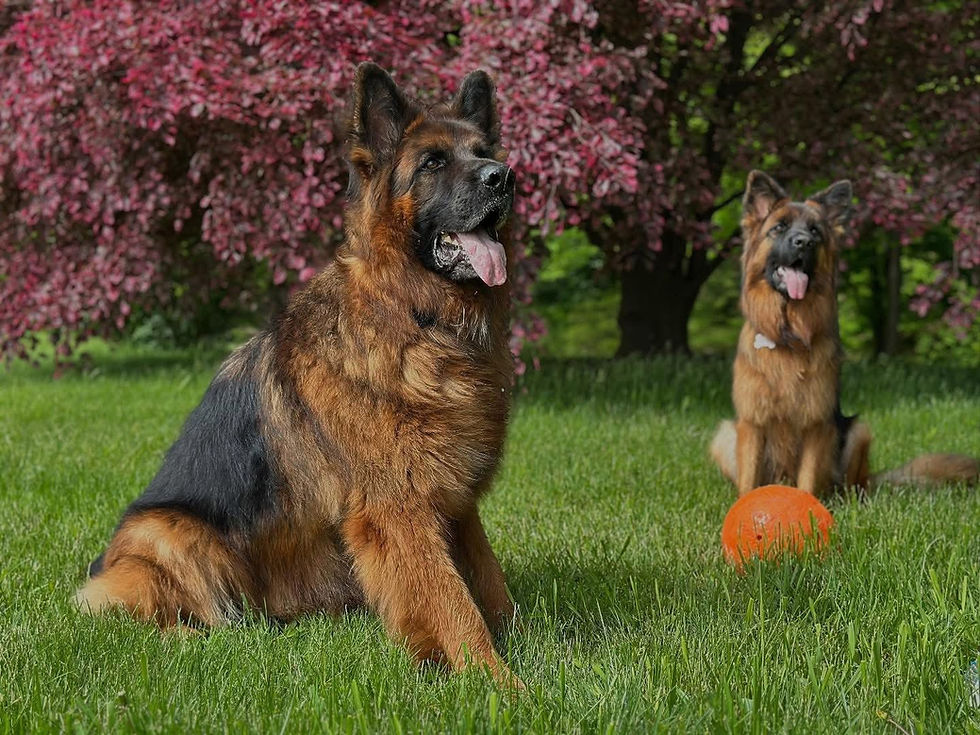
A German Shepherd can be affectionate, loyal and deeply connected to its family while still possessing the intelligence and working characteristics for which the breed was developed. That versatility is one of the reasons we love this type of German Shepherd.
However, prospective owners should never choose a German Shepherd solely because they like how the breed looks. That beautiful puppy eventually becomes a powerful and intelligent adult dog. Training matters. Socialization matters. Structure within the household matters. Most importantly, choosing a puppy whose temperament complements the home matters tremendously.
Families considering the breed can learn more about Haus-Neufus German Shepherd puppies and how we approach raising and placing our puppies.
Why Matching the Right German Shepherd Puppy Matters
Not every puppy in a litter is identical. Even puppies from the same parents can differ in confidence, energy, engagement, drive and personality. One family may want an active companion with the potential to pursue advanced obedience or dog sports, while another may primarily want a confident family companion.

The "best" puppy isn't automatically the boldest puppy, the calmest puppy or even the puppy that walks over first. The best puppy is the puppy whose individual characteristics fit the home waiting for it.
That is why understanding our adult dogs, observing our puppies as they develop and learning about prospective homes are all important parts of our process. Families researching a future puppy can view our upcoming West German Show Line German Shepherd litters or look through our previous German Shepherd litters to see dogs produced by Haus-Neufus.
Temperament and Training Are Not the Same Thing
Another important distinction is the difference between the temperament a dog inherits and the behaviors a dog learns. Training can shape behavior, good socialization can provide a genetically sound puppy with valuable experiences, and clear expectations can help an intelligent German Shepherd understand how to successfully live in a human household.
But training isn't a substitute for sound genetics, just as excellent genetics aren't a substitute for training. We need both.
That philosophy is one reason training has always been intertwined with our breeding program. Our involvement with German Shepherds began through obedience training in 2004 and expanded into Schutzhund and the conformation show world in 2008. Training remains an important part of how we understand and evaluate the dogs in front of us today. Owners looking for professional help with their own dogs can also explore Jana's dog training programs through Noble K9 Training.
Why We Don't Breed German Shepherds for Looks Alone
There is no denying the beauty of a West German Show Line German Shepherd. Rich pigmentation, beautiful movement, strong expression, correct breed type and a magnificent coat are often what initially draw people to these dogs.
But when that German Shepherd lives beside you for the next decade or more, beauty isn't what determines the relationship you have with the dog. Character does.

The dog has to live in the real world. It has to learn, experience new environments, interact appropriately with its family and adapt to everyday life. For dogs being shown, trained or worked, it also has to perform. That is why our breeding philosophy extends beyond appearance and why we emphasize health, temperament, structure, intelligence, trainability and working ability when evaluating the dogs that represent Haus-Neufus.
Our German Shepherd accomplishments and show results provide another look at the dogs and generations behind our breeding program.
What Are Zitan's Puppies Like?
Ultimately, a breeding dog's importance isn't measured only by his own accomplishments. We also watch what he contributes to his offspring.
As Zitan's offspring have developed, we have been especially pleased to see qualities we value appearing in the next generation, including beautiful breed type, pigmentation, strong heads, confident personalities and family-oriented temperaments. That doesn't mean every puppy will be a copy of Zitan. Genetics don't work that way. Every breeding combines two individual dogs and two pedigrees, and every puppy is still an individual.

Seeing desirable characteristics reproduced in offspring, however, is an important part of evaluating a breeding dog over time. Families can explore our previous West German Show Line German Shepherd litters to see more of the puppies and dogs produced through the Haus-Neufus program.
So, What Should a West German Show Line German Shepherd Be Like?
There is no single personality shared by every West German Show Line German Shepherd, and bloodline labels alone cannot tell you everything about an individual dog. But there are qualities we believe are worth striving for.
We want confidence without unnecessary instability, drive without chaos, intelligence paired with a willingness to work with the handler, power with clarity and beauty supported by correct structure. We want enough versatility for the dog to move between training, showing, activity and normal life with its family.
In other words, we want a German Shepherd capable of doing something, but also capable of simply being with you.
That is the balance.
Zitan Represents What We Want to Preserve
We're proud of Zitan's beauty, his V ratings, his IGP2, his KKL, his health testing and the evaluations he has earned. But those accomplishments aren't the only reasons he is important to Haus-Neufus.
We're proud of the dog underneath them: a confident, social and clear-headed German Shepherd who wants to work, can think, possesses presence and character, and can settle when the work is finished. As a breeding dog, we now have the opportunity to watch how those qualities carry forward into another generation.
That is what responsible breeding means to us. It isn't chasing a photograph, breeding for a single characteristic or simply producing German Shepherd puppies. It means trying to preserve the complete German Shepherd Dog.
Beautiful enough to turn your head, capable enough to earn your respect, and with the temperament to become part of your family.
That is the German Shepherd we believe in, and that is the German Shepherd we strive to produce at Haus-Neufus German Shepherds.
Frequently Asked Questions About West German Show Line German Shepherd Temperament

Are West German Show Line German Shepherds calmer than working-line German Shepherds?
West German Show Lines are often selected for a balance of conformation, working ability and temperament, while particular working bloodlines may place greater emphasis on intense working drives. However, a bloodline label alone cannot predict an individual dog's energy or temperament. The parents, pedigree, breeding decisions, early development and individual puppy all matter.
Are West German Show Line German Shepherds good family dogs?
They can make exceptional family companions in appropriate homes. A well-bred German Shepherd should be confident, intelligent and trainable, but the breed still requires appropriate exercise, socialization, structure and training.
Do West German Show Line German Shepherds still have working drive?
They can. "Show line" should not be interpreted as meaning a German Shepherd has no working ability. Dogs such as V Zitan vom Haus Neufus demonstrate that a German Shepherd can succeed in conformation while also earning working qualifications such as IGP titles.
Is German Shepherd temperament genetic?
Genetics influence temperament, but development also involves environment, socialization, learning and training. Responsible breeding and responsible puppy raising work together rather than replacing one another.
How do I choose a German Shepherd puppy with the right temperament?
Start by choosing a breeder who understands the parents, pedigree and individual puppies rather than selecting a puppy based solely on appearance or color. Be honest about your household, experience, activity level and goals so the breeder can help identify an appropriate match.
How Can I Get a Haus-Neufus German Shepherd Puppy?
Start by reviewing our upcoming German Shepherd litters, German Shepherd puppy pricing and information and German Shepherd puppy FAQ.

When you're ready to tell us more about yourself, your family and what you're looking for in a German Shepherd, complete the Haus-Neufus puppy application.


